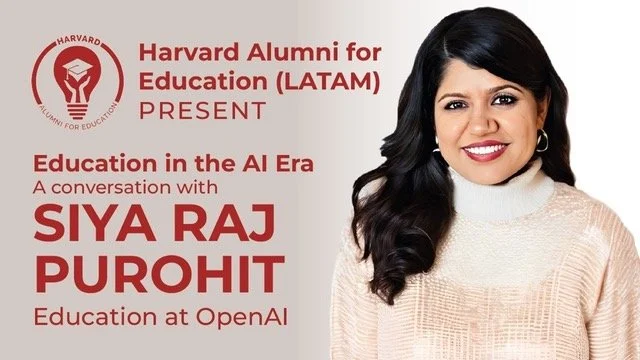
Last year, at Harvard Alumni for Education (HAED), Latin American Chapter, we had one of those rare moments when the future of education felt closer than ever. In a vibrant webinar with Siya Raj Purohit, Global Head of Education at OpenAI, we explored how AI is transforming learning. Alongside my co-directors Patricia Vázquez and Gustavo Rojas, and with an engaged audience joining from across Latin America and beyond, I found myself constantly surprised by the clarity, humanity, and urgency in Siya’s vision.
When Siya compared the evolution of AI models to stages of learning—GPT-3 as a high schooler, GPT-4 as a graduate student, and GPT-5 (just released) as a team of PhDs working together. It was impossible not to pause in surprise at this comment. Suddenly, expertise that once belonged only to elite institutions now feels accessible to anyone with curiosity. What this means for schools and universities is that the real challenge is no longer access to information but learning to collaborate with this new “team of experts,” teaching students how to question, refine, and go beyond what AI produces.
Patricia raised a concern that weighs heavily on many teachers in our region: Will AI replace us? Siya’s answer was both surprising and deeply reassuring. “Students don’t remember lesson plans or quizzes; they remember how teachers made them feel.” In that moment, it became clear that the proper role of educators cannot be replicated. AI can handle the repetitive tasks, but it is teachers who ignite passion, build trust, and inspire. This shifts the conversation entirely: rather than fearing replacement, we should reimagine classrooms so that teachers spend less time grading or preparing endless materials and more time connecting with their students on a human level.
As the discussion unfolded, Siya shared examples of how students are already using AI in ways that stretch the imagination. Some use it as a career coach to map out learning journeys for 18 months and 18 years. Others treat it as a cofounder to test ideas, launch small ventures, and even begin solving real-world problems without needing large teams. The surprise here was not just the creativity of these uses, but the implication: we need to prepare students not only to consume knowledge, but to act on it, to create, to lead. Schools could become the training ground for this entrepreneurial spirit, showing learners how to combine their vision with the practical power of AI.
Gustavo then steered the conversation toward ethics, and here Siya offered another unexpected perspective: AI is not a black-or-white debate. Transparency, reflection, and human oversight are key. She suggested something as simple as reflection forms, where students explain how they used AI in their work. At first, it sounds almost trivial, but it’s transformative—it normalizes honesty, builds trust, and ensures that AI becomes part of a responsible learning culture instead of a hidden shortcut.
Another surprise came when Siya introduced Study Mode, a new feature that applies the Socratic method to guide students with questions rather than answers. Instead of giving away solutions, it strengthens critical thinking and helps learners build a durable understanding. Listening to this, I couldn’t help but imagine classrooms where grades depend not only on the final product but on the quality of the intellectual journey students took, step by step, alongside AI.
There were other moments that opened our eyes even wider. Parents are using AI to turn their children into heroes of personalized bedtime stories. Policymakers are realizing that change will stick only if teachers lead it, not if it is imposed from above. Large-scale initiatives like the National Academy for AI Instruction in the U.S., where 400,000 teachers will soon be shaping how AI enters the classroom. Again and again, the message was clear: innovation must grow from creativity, trust, and empowerment, not fear.
Perhaps the biggest surprise of all was Patricia and Siya’s reminder that education is now shifting in 90-day cycles. Change is no longer measured in decades—it’s happening season by season. That pace can be dizzying, but it also means opportunity. If we stay agile, experiment boldly, and reflect quickly, we can guide this transformation with purpose and humanity.
We closed the webinar inspired, grateful, and full of questions for the future. Thank you to Siya for her generosity, Paty and Gustavo for their thoughtful leadership, and the incredible HAED community whose energy and curiosity made the event truly global. What remains with me most is the conviction that AI is not here to take away what makes education human—it is here to give us back the time and the freedom to deepen it. In the same spirit, I crafted and improved this reflection with the help of AI, not by accepting the first answer, but by doing precisely what Siya recommended: iterating through questions and prompts, asking for clarifications, and refining until the message, and principally the learnings of the conversation, felt complete. In that process, I experienced firsthand what Siya called the real opportunity of AI: “Not easy answers, but a deeper understanding through questioning and iteration, leading us to embrace collaboration and exploration in this new human-AI partnership”.
You can watch the recording of this webinar here: Webinar with Siya Raj! | Harvard Alumni for Education - Latin America and Caribbean
Erik Ramírez Ruiz
Co-Director, Harvard Alumni for Education (Latin America)
Director Ejecutivo, Radix Education