
By Harvard Alumni for Education Latam
School leadership shouldn't be about drowning in paperwork. Yet that's exactly where most principals find themselves—buried in administrative tasks while the real work (helping students learn) gets pushed aside.
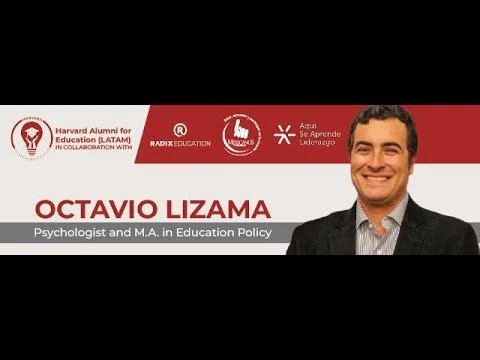
Last week, we had the chance to sit down with Octavio Lizama, principal of Betterland School in Chile, to dig into a question that keeps coming up in my conversations with school leaders: How do you actually free up time to focus on instruction?
Octavio leads a high-vulnerability school where results matter—not as metrics on a report, but as doors opening for students who've historically been told those doors weren't for them. His approach combines rigorous academic expectations with intentional socioemotional work. And he's figured out how to align his entire team around that mission without burning everyone out.
AI as a time multiplier
Here's the uncomfortable truth Octavio names early in our conversation: most principals spend 70–76% of their time on administrative tasks. The fraction left for instructional leadership—the work that actually moves learning—is tiny. Recognizing this trap is step one. You can't redesign what you haven't named.
Octavio introduced a practical method from a recently published book " El Director LIBRE" (Liberate, Identify, Search, Reinforce, Expand). The core idea: stop relying on individual willpower to protect your time. Instead, turn good decisions into systems and automations that hold even when things get chaotic. It's not about working harder—it's about building structures that do the heavy lifting.
We spent time on how AI tools can process documents, draft reports, and analyze assessments—tasks that used to eat hours. But Octavio's key point wasn't about the technology itself. It was about what you do with the time you recover. If you're not reinvesting those hours in classroom observation, teacher feedback, and pedagogical coaching, you've missed the point.
The webinar kept returning to a key question: Does this meeting, form, or procedure actually contribute to student learning? That question becomes your filter for deciding what to simplify, delegate, or eliminate entirely. Without clarity of purpose, time management is just rearranging deck chairs.
The webinar’s Q&A surfaced the real tensions school leaders face:
How do you start without overwhelming your team? Octavio's answer: early wins. Automate one repetitive task. Redesign one meeting. Simplify one report. Build momentum before scaling.
What about bureaucratic demands from above? The reality is that ministry requirements and external inspections won't disappear. The strategy is to standardize formats, document processes better, and use digital tools to comply faster—not to fight the system, but to spend less manual time feeding it.
How do you get others on board? Distributed leadership matters. Coordinators, department heads, and teachers need to protect their own time too. The goal is a culture where everyone guards space for deep pedagogical work.
How do you know it's working? Feelings aren't enough. Track simple indicators: percentage of time on instructional activities, number of classroom observations, feedback cycles completed. Connect those to learning outcomes.
If you lead a school or support those who do, this conversation offers a realistic path forward—not a silver bullet, but a clear framework for reclaiming what matters most.